



A few years ago, I made the switch from a traditional component-based home-theater audio system to a soundbar-based one for my TV viewing room. The reason? I got sick of being surrounded by so much stuff: Blu‑ray player, streamer, preamp-processor, amps, stacks of speakers—all of it connected with a tangle of cables.
It was a relief to pack all this gear away (I still have it, being a hoarder) and instead rely on a single, slim bar for sound. The downside was that the first soundbars I tried didn’t sound all that good, especially with music. But soundbars have steadily improved over the years, with newer models such as the Bluesound Pulse Cinema (US$1499, CA$1699, £1149, €1299) stepping up their performance with features like upfiring speakers for Dolby Atmos immersive audio and built-in streaming for hi-rez music services like Tidal and Qobuz.
Bluesound is no stranger to soundbars. The original Bluesound Pulse Soundbar combined the company’s BluOS multiroom streaming platform with a two-channel speaker component designed by Paul Barton of PSB Speakers fame. That was followed by the Pulse Soundbar+, a model with virtual Dolby Atmos processing.
The new Pulse Cinema goes full-on Dolby Atmos with a 3.2.2-channel, 16-driver speaker array and 500W of amplification. (Bluesound also has a new, more compact soundbar, the 2.1-channel Pulse Cinema Mini, that uses virtual Dolby Atmos and costs US$999.) Like the Pulse Soundbar+ before it, the Pulse Cinema can be augmented with Bluesound’s Pulse Sub+ wireless subwoofer (US$899), and Pulse Flex 2 (US$399 each) or Pulse M all-in-one speakers (US$499 each), for a full surround-sound package.
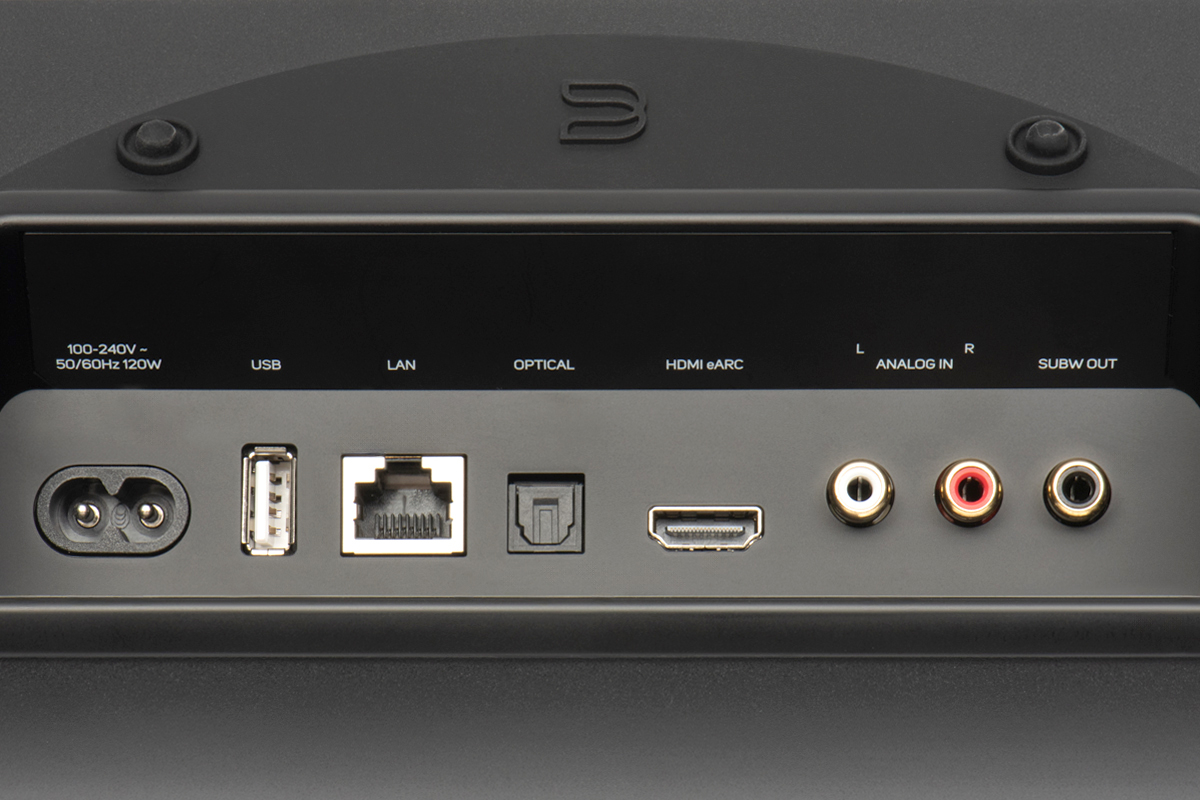
The Pulse Cinema’s two upfiring speakers deliver the height effects in Dolby Atmos soundtracks by bouncing sound off your room’s ceiling (a flat ceiling will provide the best results). HDMI eARC and optical S/PDIF (TosLink) ports allow for connection to a TV, and, unusually for a soundbar, the Pulse Cinema features a pair of RCA line-level inputs, allowing you to connect a CD player or turntable (you’ll need a phono preamp for vinyl playback) and play those sources through the soundbar or through other BluOS-enabled components in your home.
Like all BluOS-enabled components, the Pulse Cinema supports Apple AirPlay 2, Spotify Connect, Qobuz Connect, and Tidal Connect. Additionally, the BluOS Controller app lets you link up to 23 music and internet radio services (including Qobuz and Tidal, which can be accessed from the BluOS app or from their native apps via their Connect functions). Hi-rez audio (up to 24‑bit/192kHz), DSD256, and MQA are supported, and the Pulse Cinema is Roon Ready. It also features Bluetooth aptX Adaptive (two‑way, with the option to use headphones for private viewing). Google Cast is not supported, but there is a BluOS skill for Alexa that lets you do things like controlling volume via voice command. I don’t mess with Alexa, so I can’t confirm how well (or not) this works.
Outside and inside
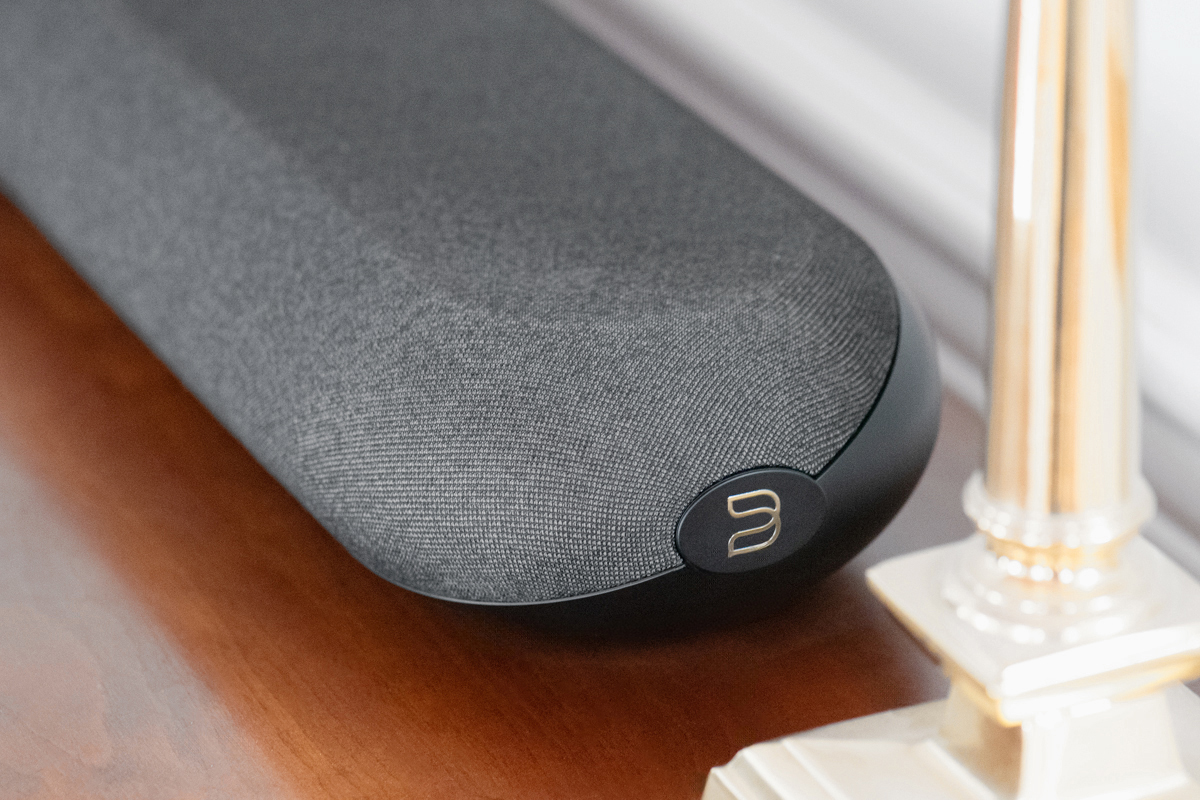
Soundbars are notorious for bland design, with matte-black plastic being the default finish on most models. Bluesound doesn’t depart radically from the typical soundbar design template, though the Pulse Cinema does add flourishes that elevate it for the category.
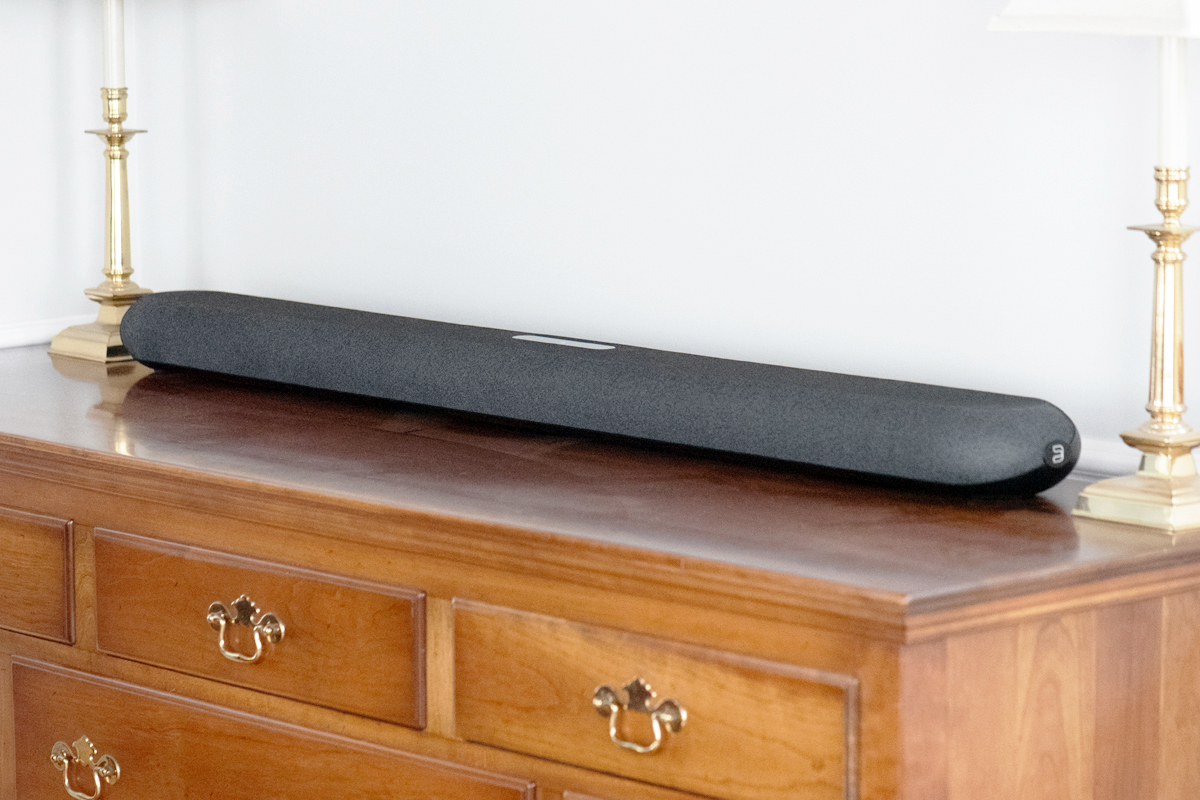
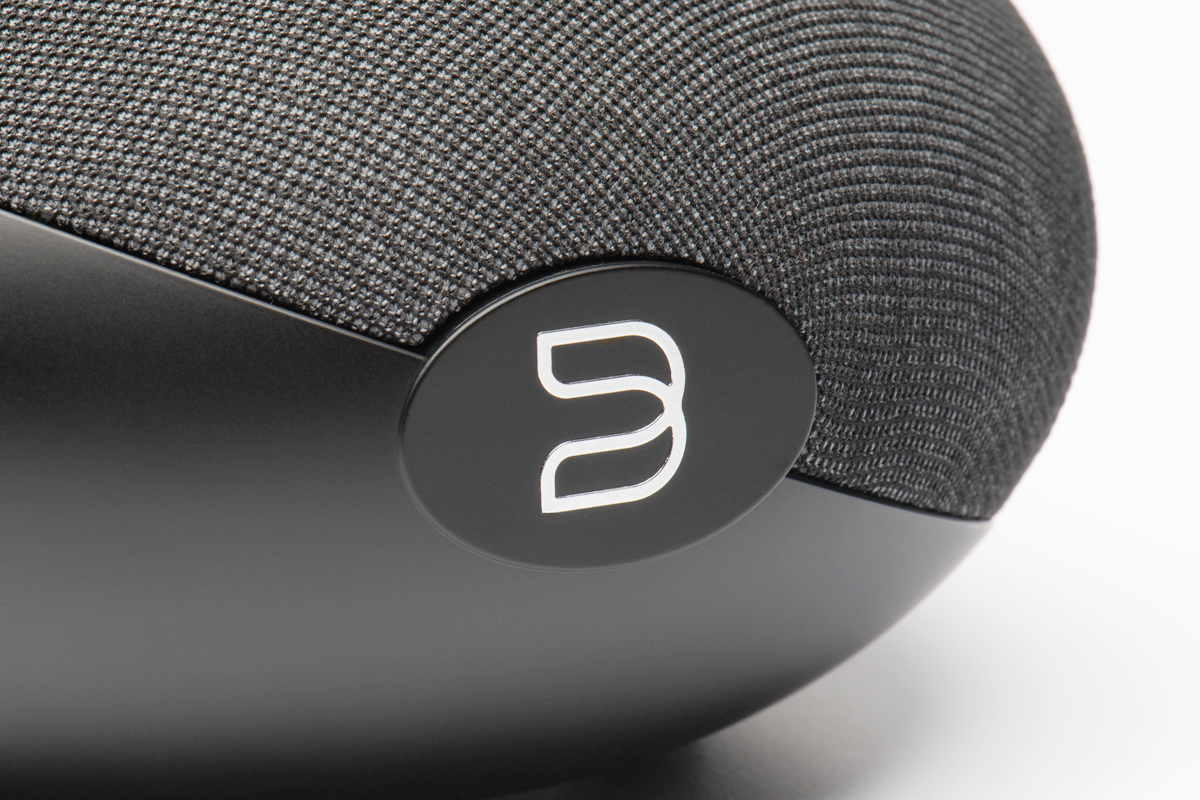
Mainly, the elongated, pill-like Pulse Cinema’s aluminum chassis is covered by a dark gray fabric mesh with a good quality of fit and finish. It’s designed for either a tabletop or wall-mount installation, with an internal gyroscope automatically recognizing the orientation, and the soundbar’s DSP optimizing the sound output for either setup. Wall-mounting hardware is included in the box, along with a template to guide the installation. HDMI and ethernet cables are also included.
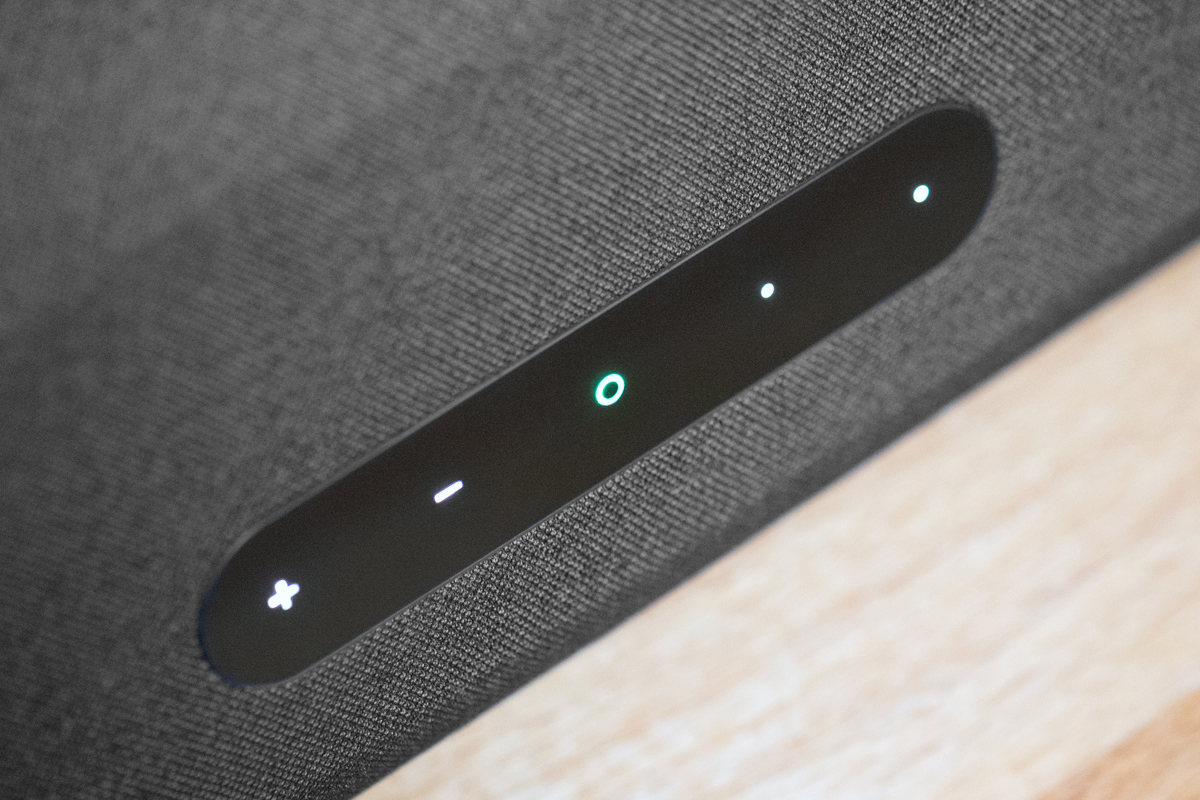
Bluesound doesn’t provide a remote control with the Pulse Cinema. All adjustments are carried out in the BluOs app, and HDMI CEC support lets you use your TV’s remote to adjust volume. A BluOS RC1 remote can be purchased separately for US$69, and it can also be used to control other BluOS products in your home.
Along with its HDMI eARC, optical digital, and analog stereo connections, the Pulse Cinema provides ethernet and USB type‑A ports. There is also an RCA subwoofer output with a fixed 90Hz filter, which will let you use the soundbar with subs other than the wireless Bluesound Pulse Sub+.
The Pulse Cinema uses a 0.75″ tweeter and a 1.5″ × 3″ midrange driver for its left, center, right, and dual upfiring speakers, with each driver powered by a 38W amplifier. The dual 4″ woofers get 65W of power each, and there are four 4″ passive radiators. No frequency-response spec is provided, though THD+N is specified at 0.03%.
Setup and software
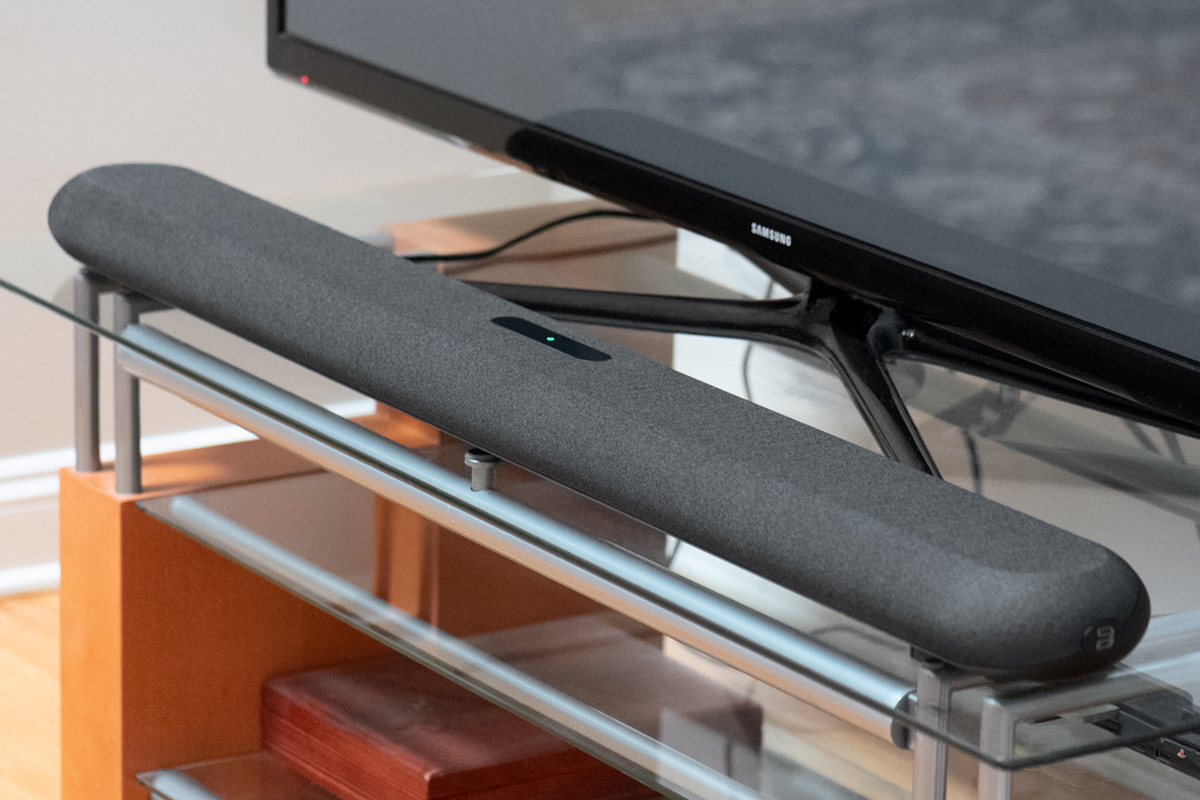
Setting up the Pulse Cinema couldn’t be easier, especially if you opt for a tabletop installation as I did. Measuring 2.9″H × 47.1″W × 5.5″D, the soundbar proved a good match width-wise for my 75″ Hisense TV, though its near-3″ height meant it just barely cleared the bottom edge of the screen. For hookup, I used HDMI eARC—a necessity if you want Dolby Atmos, which optical S/PDIF doesn’t support.
The next setup step is to download the BluOS Controller app. After using the app to connect the soundbar to my home’s Wi‑Fi, I added the Tidal and TuneIn internet-radio services in the Music tab, and signed in to my respective accounts. The Music screen provides buttons to switch among the soundbar’s analog, optical digital, and Bluetooth inputs for music playback, and it also lets you set up a default listening mode (Music, Movie, Late Night, and Off) along with auto-sensing for automatic switching to those inputs when a signal is detected.
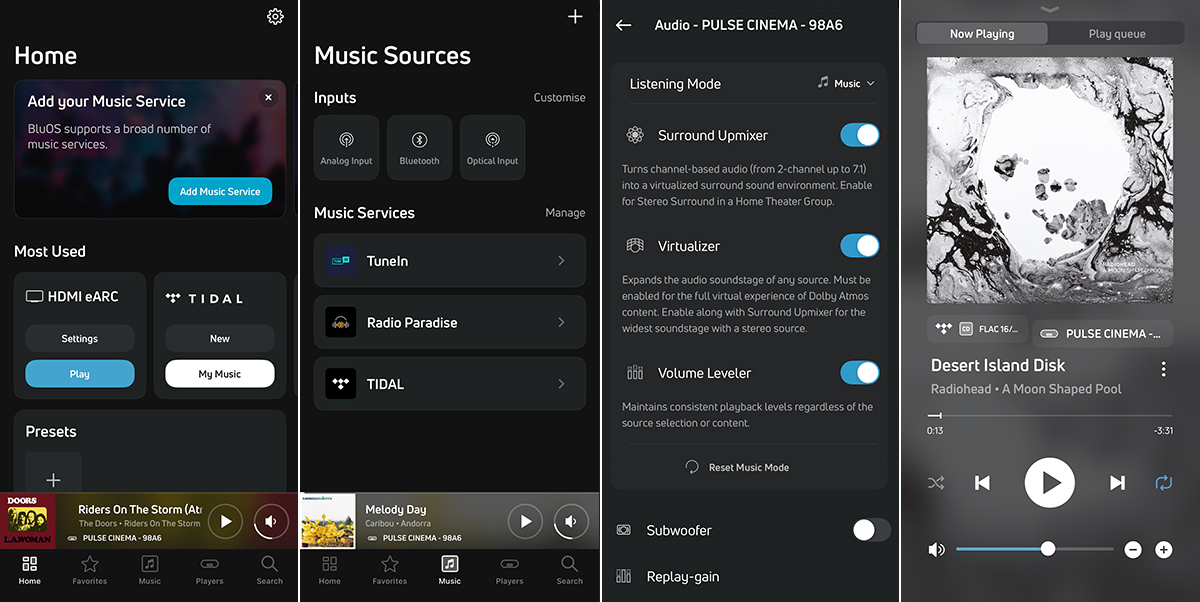
No matter which listening mode you select, options in the app’s Audio submenu let you enable and disable the Surround Upmixer, Virtualizer, and Volume Leveler. The first takes any channel-based source, from 2.0 to 7.1, and upmixes it to Atmos surround, while the second expands the soundstage for the widest possible presentation. Volume Leveler, as the name implies, maintains a consistent playback level, which will prevent your ears from getting blown out by commercials when watching TV. There are no EQ controls in the app, and there’s also no room correction, which is a feature found in many other soundbars, even basic ones.
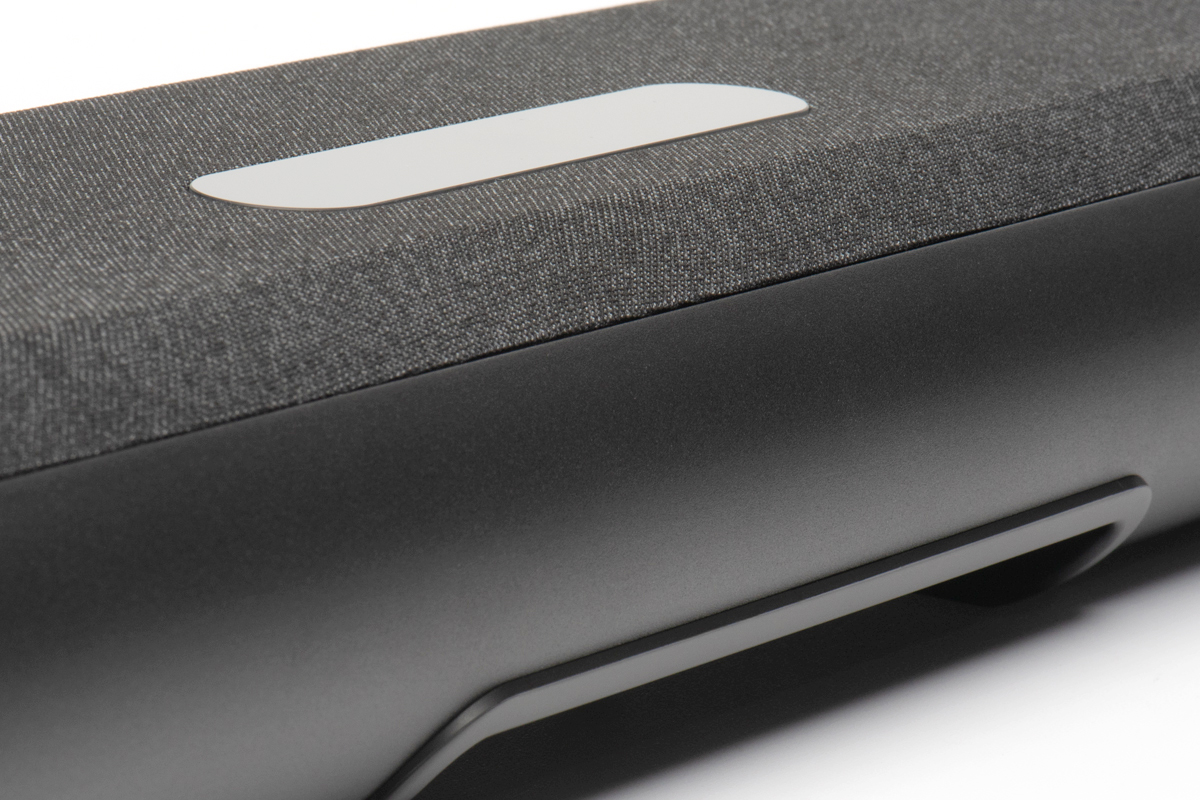
The soundbar’s top panel (or front surface if wall-mounted) features a series of touch-sensitive controls and LED indicator lights. The controls let you adjust volume manually and access the soundbar’s two presets (configurable in the BluOS app). The LED indicators have a cryptic range of color and blink sequences that correspond to different functions. You’ll need to consult a manual to understand them, which is the main reason I prefer an alphanumeric display on soundbars.
Movies
For movie and TV viewing (and most Dolby Atmos music listening) I used an Apple TV 4K streamer and Oppo UDP-203 4K Blu‑ray player connected to my TV, with the audio bitstreams routed to the Pulse Cinema via its HDMI eARC port. For streaming, I watched movies and shows on Apple TV and HBO Max, and also dug into my 4K Blu‑ray collection for reference movie scenes.
F1 is an okay movie that strangely received a Best Picture nomination for the 2026 Academy Awards. It’s also up for Best Sound—a nomination it does deserve. Streamed in Atmos from Apple TV, the powerful sound of race-car engines mixed with Led Zeppelin’s “Whole Lotta Love” in the opening scene had a thoroughly propulsive quality, with Jimmy Page’s classic riff nicely synced with the interior and exterior racing shots (F1 is also up for Best Editing). The scale of the sound was impressively tall and wide, and there was a good sense of surround envelopment for a single-bar system, though your mileage may vary based on your room layout.
The last time I was in Las Vegas, I asked a cab driver what it was like to have F1 racing in the city, and his reply was, “Loud.” The movie’s racing scenes definitely offered a taste of that, with the roar of the engines and screeching tires on turns providing a not only visceral but near-pummeling effect. The Pulse Cinema handled it all easily, and at the same time managed to cleanly convey other soundtrack elements like the radio communication between the drivers and pit crews.
The 2021 James Bond movie No Time to Die doesn’t reach the aggressive sonic heights of F1 during its action sequences, but it does have a nicely balanced and immersive Atmos mix. Watched on 4K Blu‑ray, in a scene where Bond (Daniel Craig) and Madeleine (Léa Seydoux) enjoy pillow talk in a hotel room, their dialog sounded clear and natural, with a good sense of body to Craig’s deep voice. An opera LP being played on a phonograph in the background blended smoothly with the other soundtrack elements, with the Pulse Cinema managing to clearly define its position in the room.
Music
Bluesound is a hi-fi brand at its core, so it’s reasonable to expect that music playback was strongly considered in the Pulse Cinema’s design. This is the first Bluesound soundbar I’ve tested, and I’ll admit that my expectations were high for the music side of the equation. The Pulse Cinema did not disappoint. The voicing is a bit treble-forward—typically a good thing for movies and TV, where dialog clarity is of primary importance. When listening to music, I occasionally found myself wishing for an EQ adjustment that would let me dial back the highs a bit, but overall, I found the Pulse Cinema’s performance with music superior to the vast majority of soundbars I’ve used.
Listening to Radiohead’s “Desert Island Disk” from the band’s 2016 album A Moon Shaped Pool (16‑bit/44.1kHz FLAC, XL Recordings / Tidal), Thom Yorke’s vocals were centered and emanated from a position well above the horizontal bar sitting below the TV’s screen. The acoustic guitar had a full quality and a natural timbre, and the song’s subtle electronic drones floated out widely to the left and right, creating an effect like a travel pillow wrapped around the head. For two-channel tracks like this one, I preferred the Music mode with Surround Upmixer and Virtualizer settings switched on, as it delivered the widest stereo presentation.
“Imaginary Friends” by Deadmau5 (16/44.1 FLAC, Mau5trap / Tidal), from the album W:/2016ALBUM/, is anchored by deep, powerful electronic beats. Any standalone soundbar would be challenged to reproduce it with even an average level of fidelity, but the Pulse Cinema met that challenge. It didn’t exactly hit sub-bass territory, but the track’s throbbing beats sounded punchy and clean, and they were well balanced with the synths and other electronic elements.
One disappointment I had with the Pulse Cinema was that you can’t play Dolby Atmos tracks on Tidal via the BluOS streaming platform. That’s a Tidal issue, apparently, and Atmos tracks are instead converted to high-rez stereo FLAC. Fortunately, I was able to play Atmos tracks on Apple Music in Dolby Atmos via an Apple TV 4K streamer connected to my TV, which supports an HDMI eARC connection to the Pulse Cinema.
Cueing up my Apple Music Atmos Audio Test playlist on the Apple TV 4K, I settled on Kraftwerk’s “Nummern / Computerwelt (Live)” from 3-D: Der Katalog (Dolby Atmos, Kling Klang / Apple Music). I’ve listened to this track on multiple Dolby Atmos speaker systems, including some pretty high-end ones, and I was honestly knocked out by how good it sounded on the Pulse Cinema. Panned electronic beats skittered widely across the front of the room, and the vocal samples seemed to emanate from all over, including from above and to the sides of my head. Overall, the music sounded lively and dynamic, with a clean spatial separation of mix elements that you don’t typically hear with a soundbar.
The Pink Floyd Wish You Were Here (50th Anniversary) Blu‑ray box set (Columbia 19802876739) features a Dolby Atmos mix by James Guthrie, who did the original 5.1-channel Dolby Digital mix (also included). In my experience, Atmos played back on disc always sounds better than streamed Atmos (as it should, since Atmos soundtracks on disc are uncompressed), and when I played “Welcome to the Machine” on the Pulse Cinema, it displayed a level of density, texture, and detail that surpassed the streamed version (available on Apple Music). Not only that, but the combined effect of the song’s guitars, synth, and vocals created a wall of sound that towered well above the Bluesound soundbar, which effectively disappeared into the immersive Atmos mix.
Comparison
Klipsch’s Flexus Core 200 soundbar (US$575) has a 3.1.2-channel speaker array with a similar driver arrangement to the Pulse Cinema; as mentioned, however, the Bluesound additionally features a quartet of 4″ passive radiators alongside its dual 4″ woofers. At 3.1″H × 44″W × 4.9″D, the Flexus Core 200 is more compact than the Pulse Cinema, though the height is the same. Power is specified at 185W total and frequency response at 43Hz–20kHz.
The Klipsch’s connections are the same as those on the Bluesound, minus the analog input. Streaming capabilities are limited to Bluetooth, though the Klipsch has a control app with multiband EQ and channel-level (including for the front right and left height speakers) adjustments, along with a dialog-boost mode. The Klipsch also includes a remote control and features a large alphanumeric LED display for visual feedback.
The Flexus Core 200 sounds very good for the price, with strong bass and an impressive vertical scale to the sound with Dolby Atmos content. Playing F1 on the Klipsch, the front soundstage wasn’t as wide, and there wasn’t the same wraparound effect I heard with the Bluesound. The Klipsch can be scaled up to a full 5.1.2- or 5.1.4-channel system by adding the company’s optional surround speakers and subwoofer, however, and doing so would cost around the same or even less than the standalone Pulse Cinema.
I listened to the same music tracks on the Klipsch as on the Bluesound, and here’s the short version: the Bluesound soundbar provided a more immersive experience than the Klipsch, with tighter bass and more powerful and dynamic overall presentation. Yes, you’ll be paying quite a bit more for the Pulse Cinema, but you’ll definitely hear where that money went.
Conclusion
At US$1499, the Bluesound Pulse Cinema is at the higher end of the soundbar price spectrum, where it sits between popular standalone Dolby Atmos models such as the Sonos Arc Ultra (US$1099) and KEF XIO (US$2499.99). It provides excellent overall performance with movie and TV soundtracks and music, and its two-way installation option provides flexibility for both tabletop and on-wall setups.
As much as I loved having the Pulse Cinema sitting under my TV, I do have some notes. At this price, it’s not unreasonable to expect DTS:X processing, especially when popular streaming services such as Disney+ are starting to add DTS:X soundtracks to movies. Also, the Pulse Cinema’s lack of EQ settings or room correction is puzzling, particularly because Bluesound’s sister brand NAD features Dirac Live in many of its recent integrated amplifiers, and Bluesound’s Node streaming preamps are Dirac Live Ready. And would it have been too much of an issue to include a remote control? Sure, the Pulse Cinema supports HDMI CEC for volume control, and you can configure everything you need using the BluOS app, but not everyone will want to pull out their phone to make even basic adjustments. There’s also the issue of no Google Cast support, though as an iPhone owner, this wasn’t a problem for me.
Those notes aside, the Bluesound Pulse Cinema delivers wonderfully immersive sound with powerful, satisfying bass and impressive dynamics for a standalone soundbar. The BluOS app is intuitive and easy to use, and its built-in music streaming, including the ability to stream hi-rez music from Amazon Music, Qobuz, and Tidal, make it a superior music-playback option compared to similar-priced Dolby Atmos soundbar systems from brands such as Sony and Samsung. If, like me, you find yourself wanting to streamline the hardware footprint in your viewing space, the Pulse Cinema can easily replace a lot of stuff, and it will do so with a surprisingly small cost in sound quality.
. . . Al Griffin
Associated Equipment
- Soundbar: Klipsch Flexus Core 200
- Display: Hisense 75U9N
- Sources and control devices: Apple TV 4K streamer, Oppo UDP‑403 Ultra HD Blu‑ray player
- Network: Netgear Orbi AC3000 Tri‑band Wi‑Fi
Bluesound Pulse Cinema soundbar
Price: US$1499, CA$1699, £1149, €1299
Warranty: One year, parts and labor (electronic components), five years, parts and labor (drivers)
Bluesound
633 Granite Court
Pickering, ON L1W 3K1
Canada
Phone: 1-855-531-4666
Fax: (905) 831-6936
E-mail:
Website: www.bluesound.com